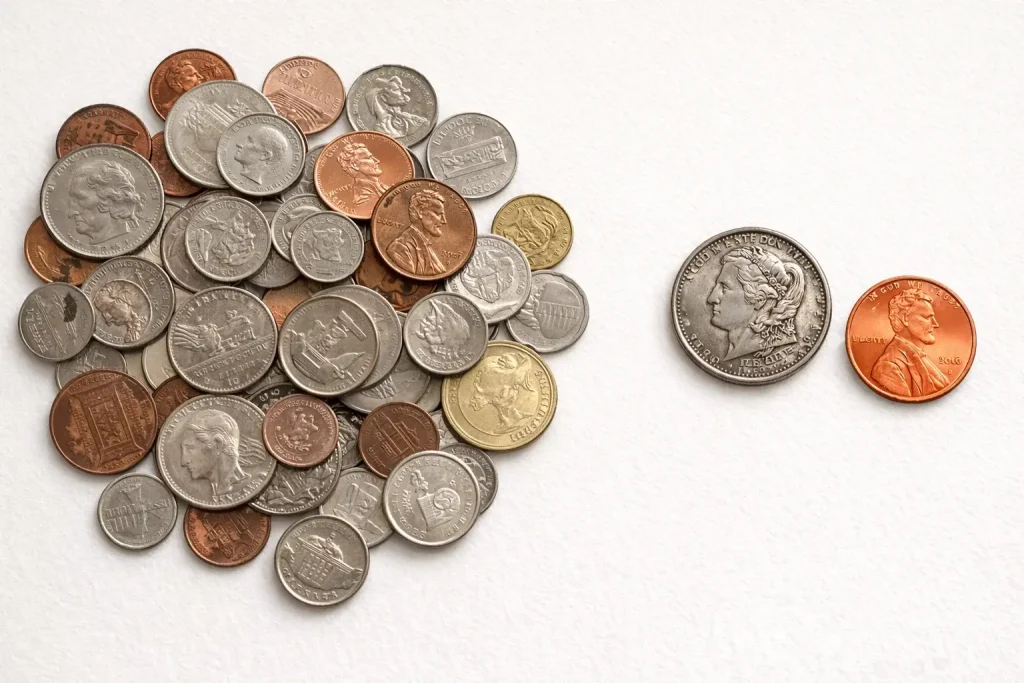
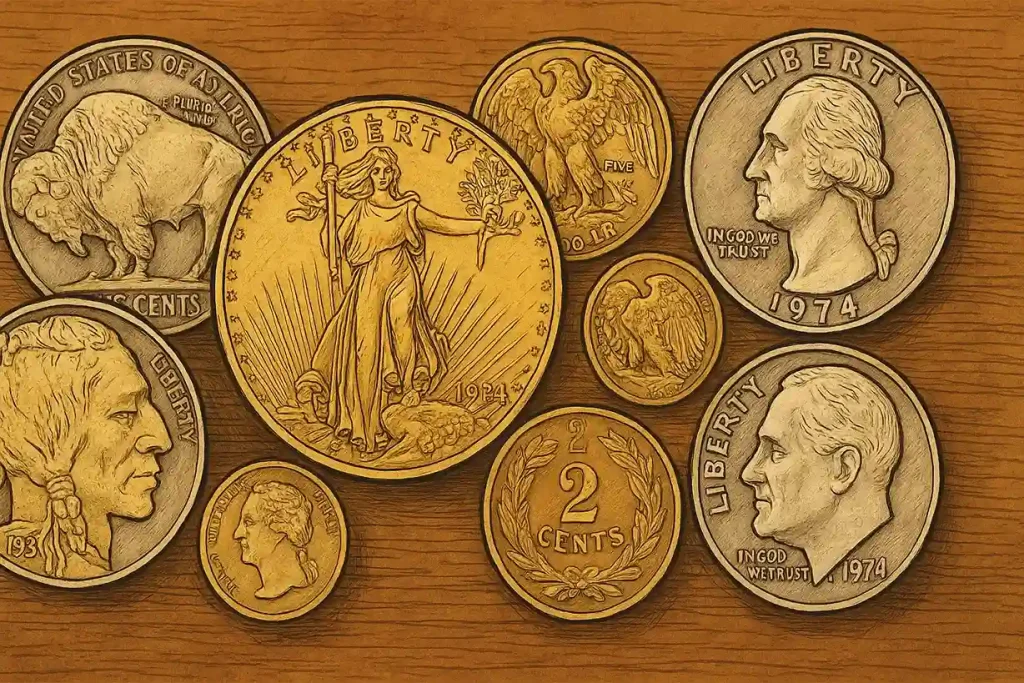
To be honest, the Lincoln Wheat Penny value isn’t that high, based on the current price of copper, but some variations may cost a great price.
If you want to understand the real value, you need to consider four main factors: the year of its manufacture, the mint where it was made, the condition, and the presence of errors or unique variations.
Main Factors
The production year and the mint mark show how many of those specific coins were made.
A high number of produced coins means a low price because the coin isn’t scarce.
A low number, on the other hand, raises the coin’s worth greatly. The pennies were made at three different mint locations:
- No mark: Philadelphia
- S: San Francisco
- D: Denver
The most valuable coins usually have the “S” or “D” mint marks, the production numbers in San Francisco and Denver often being much lower than the huge numbers produced in Philadelphia.
For instance, a 1931 penny made in Philadelphia has a massive number made, giving it a minimal price, while a 1931-S penny, produced in San Francisco, saw low production, making it a valuable coin even in used condition.
Grading
A coin’s condition is the central point deciding its market price.
Even a scarce coin won’t reach its highest value if it looks worn out.
Condition grading uses the international Sheldon scale, with the best score being MS-70, meaning perfect, never-used condition.
- G-4 is greatly worn down, the date and words being easy to read, but the design looks flat.
- VF-20 showing medium wear, people can see small details in Lincoln’s hair and the wheat stalks clearly.
- AU-50 exists on the highest points of the design, with more than half of the original shiny surface remaining.
- MS-60 hasn’t been used in circulation but might show marks or scratches from being stored in a canvas bag at the mint.
- MS-65 has its full original shine and only a few small marks.
The difference in cost between a G-4 coin and the same coin in MS-65 condition can be several hundred times larger.
Collectors pay high amounts for coins in MS condition, particularly if the coin has a full, undamaged red copper color.
Coins with this full red color are priced higher than coins that are red-brown or fully brown.
Rare Dates and Error Variations
Some coins stand out greatly in value because of a very small production number or errors made during the production process.
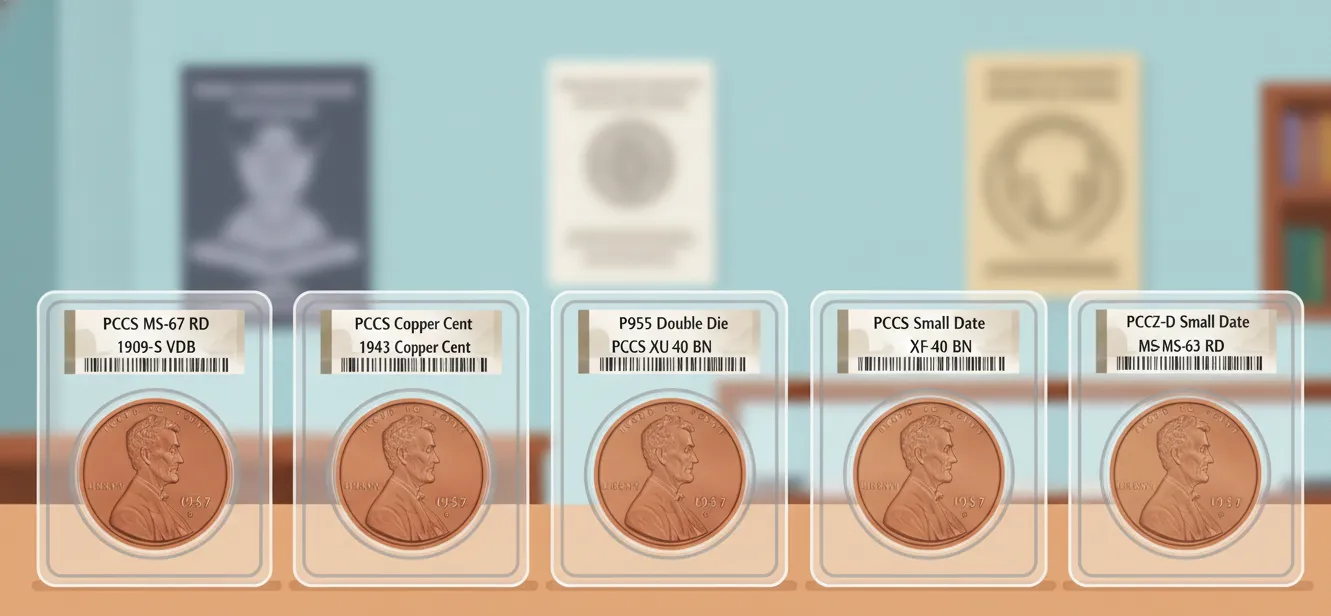
1909-S VDB
The 1909 coin, produced in San Francisco, shows the designer’s initials, VDB, placed on the reverse.
These letters were quickly removed due to public discussion, making only 484,000 coins available, and rating it the most valuable standard coin in the whole set.
1914-D
This coin, made in Denver, had a production number of just 1,193,000 pieces, placing it among the most scarce coins in the series.
People often fake this coin, changing the “S” mark or taking the mark off a coin from Philadelphia, meaning careful checking is needed.
1931-S
The production number for this coin, produced in San Francisco in 1931, was only 866,000 pieces.
This was during the Great Depression, explaining the low number of coins made.
This coin is greatly sought after by collectors, holding a high price even in used condition.
1922 No D Missing Mint Mark
In Denver, the machine die used for striking coins was so worn or poorly cleaned that the “D” mark didn’t print.
The mark-less coin from 1922 must be checked for true authenticity, its cost being much higher than a normal 1922-D coin showing a clear mark.
1955 Double Die Obverse
The best-known error in the series is the 1955 Double Die Obverse, created by a shift in the machine die during striking, causing the letters and date to look doubled and blurry.
This doubling is easily seen on the words “LIBERTY” and “IN GOD WE TRUST”, allowing coin value to reach several thousand dollars in high condition.
War Years and Metal Change
During the time of World War II, especially in 1943, the US government faced a strong lack of copper, which was needed for making military ammunition.
As a result, the penny’s metal content was changed.
1943 Steel Cent
The 1943 coins were made from steel, coated with a thin layer of zinc.
These coins appear silvery or light gray, making them stand out sharply from the usual copper pennies.
Steel pennies from 1943 are common and don’t have a high price, except for coins in perfect condition like MS-67 and above.
1943 Copper/Bronze Cent
This is one of the most valuable coins in American coin collecting.
Some steel blanks were missed by the press or wrongly struck using old copper blanks.
Only about 20 real copper pennies from 1943 exist, meaning the cost for such a piece reaches amounts with six zeros.
1944 Copper Cent Error
In 1944, the mint returned to using the copper mix. However, a few steel blanks were mistakenly struck, resulting in steel pennies from 1944. The steel penny from 1944 is a scarce error, holding a high worth.
| Year and Mint Mark | Mintage | G-4 Condition | XF-40 Condition | MS-60 Condition |
| 1909-S VDB | 484,000 | $700 – $1,000 | $1,500 – $2,500 | $4,000 – $6,000 |
| 1914-D | 1,193,000 | $180 – $250 | $400 – $600 | $2,000 – $3,500 |
| 1931-S | 866,000 | $70 – $100 | $150 – $250 | $500 – $800 |
| 1922 (No D) | N/A | $500 – $800 | $1,200 – $2,000 | $4,000 – $6,000 |
| 1955 Double Die | N/A | $25 – $50 | $150 – $300 | $1,000 – $1,800 |
| 1943 Copper/Bronze | Around 20 | $200,000+ | – | $500,000+ |
IMPORTANT NOTE: The actual market price depends greatly on the current buying interest, the selling location, and most importantly, the coin’s certification by a trusted grading service, such as PCGS or NGC, this certification assuring the coin’s authenticity and stated condition.

Pricing Common Coins
Coins made in Philadelphia from 1940 to 1958 mostly have production numbers reaching hundreds of millions, making them the most easily found.
- Coins in G-4 condition from these years often cost only 2 to 5 cents, their value being mainly for collectors wanting to complete their albums.
- Coins in MS-60 condition and better, meaning they were never used, can cost between 1 and 5 US dollars, depending on the year and if they still have the full red color.
- Pennies made after 1958 aren’t part of the wheat penny set, their production numbers being even higher, meaning they hold almost no collector value, except for their metal weight or in perfect condition.
For coins made in large numbers, their price rarely goes above 50 cents, except for perfect pieces that keep their ideal color and shine. Collecting these coins is mainly for new coin collectors trying to complete a full set by year and mint mark.
Advice for Selling and Buying
If you find a coin looking like one of the rare dates, you need to take the following steps to learn its exact worth.
- Scarce coins, such as the 1909-S VDB or the 1943 Copper, are often faked. Any coin like these must be sent for official grading to a large service like PCGS or NGC, making it nearly impossible to sell uncertified scarce coins for a high price.
- The prices in coin guides, like the coin identifier app free or Red Book, are only a starting point, not the exact market price. Real prices are set at large auctions and dealer shops.
- You must not clean the coin. Cleaning a coin, even an old one, harms its surface forever and lowers its worth greatly. Keep the coin in the same condition it was found, allowing professional cleaning only by experts if the coin is very dirty.
Learning the worth of a Lincoln Wheat Penny requires studying production numbers, looking closely at condition.
Most coins are worth a small amount, but the scarcest ones can become a large financial asset.
Other Scarce Striking Errors
Outside of the rare dates and errors already mentioned, other lesser-known but valuable production flaws can raise the price of a regular wheat penny.
- Off-Center Strike: This happens when the coin is struck not exactly in the middle of the metal blank. If the shift is between 10% and 50%, the coin can be valuable, the coin being more costly if a very large part of the design is missing.
- Rotated Die: The design on the front and back of the coin is struck at a wrong angle to each other. If the rotation is 90 or 180 degrees, the coin holds a high value for error collectors.
- Die Break: This shows up as a raised line or spot on the coin, happening when a crack appears on the machine die. If the crack is big or creates a clear raised area, such a coin can be priced higher.
- Overdate: These are very scarce coins where a new date is engraved over an older date. The wheat penny set has a few small examples, holding interest for experts.
Studying these errors requires care and often a magnifying glass, as many flaws can be very tiny.
The worth of these coins also depends on their condition and how clearly the error shows.
Conclusion
The worth of a Lincoln Wheat Penny depends on the scarcity of its year and mint mark, along with its physical condition.
Most coins, especially those made after 1940, cost only a few cents, but pieces in perfect condition or those with rare dates, such as the 1909-S VDB, 1914-D, 1931-S, or production errors, can be sold for high amounts.
Always have potentially valuable coins checked by experts, helping you avoid buying or selling fakes.